Evaluating the Challenge Negative Thoughts KDP Journal
When repetitive, self-critical thinking patterns begin to interfere with daily life, finding structured ways to interrupt and reframe those patterns becomes essential. The Challenge Negative Thoughts KDP Journal is a downloadable, print-ready resource designed to help individuals identify, examine, and reshape unhelpful thinking styles. Built around principles found in cognitive behavioral approaches, this 120-page interior offers a series of fillable templates and therapy worksheets that guide users through a step-by-step process of mental reframing. Because it is formatted for self-printing and Amazon KDP publishing, it occupies an interesting space between a professionally bound workbook and a purely self-guided notepad. Understanding how this tool works, where it excels, and where alternatives may serve you better can help you decide if it fits your current mental health support strategy.
What the Challenge Negative Thoughts KDP Journal Offers
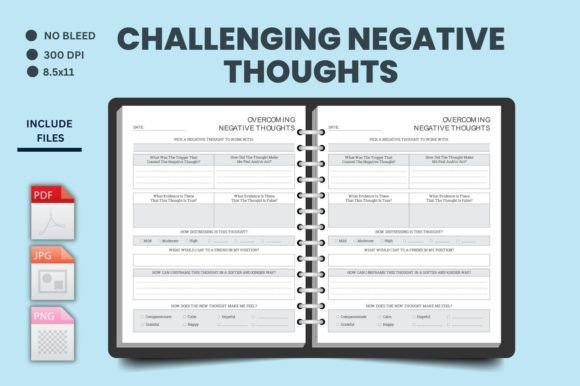
At its core, this journal is a collection of structured prompts and worksheets aimed at making the process of challenging automatic negative thoughts more tangible. Rather than leaving you to battle abstract worries on your own, the pages break the task into concrete steps. You are encouraged to write down the specific thought troubling you, identify the cognitive distortion at play—such as catastrophizing, black-and-white thinking, or emotional reasoning—and then examine the actual evidence supporting or contradicting that thought. From there, the template guides you toward constructing a more balanced, realistic alternative.
The product includes high-resolution files in JPG, PNG, and PDF formats at 300 dpi, sized at 8.5 by 11 inches with no bleed. This makes it straightforward to print at home, take to a local print shop, or upload to Amazon KDP for a physical bound copy. The interior pages are designed to be clean and organized, functioning as a planner and organizer for your mental exercises. For someone who values having a dedicated space to track patterns in anxiety, emotion, and mindset, this fillable template system can transform an abstract therapeutic concept into a repeatable, practical habit.
Reasons Someone Might Explore This Resource
People often turn to tools like this when they feel stuck in loops of anxious or pessimistic thinking. Perhaps you have already read about cognitive behavioral therapy and understand the idea of challenging automatic thoughts, but struggle to apply it consistently without a guide. A self help printable of this nature offers a middle ground. It does not replace working with a licensed therapist, but it can serve as a mental health counseling aid between sessions or as an introduction to structured self-reflection.
Another common motivation is the desire for privacy and autonomy. Not everyone feels ready to speak openly with a professional, and a fillable template kept in a personal notebook or on a device can feel safer as a first step. The simple act of seeing a negative note written down and then methodically countered can build confidence and a sense of control over one's inner dialogue. For individuals who already journal, adding a structured worksheet dimension can deepen the practice, moving it from freeform expression toward deliberate cognitive restructuring.
Benefits and Practical Strengths of This Approach
One of the clearest benefits of the Challenge Negative Thoughts KDP Journal is its emphasis on repetition and routine. With 120 pages, you have enough material to work through over several months, which is crucial because reframing deeply ingrained thoughts requires practice. The format encourages you to return to the process again and again, gradually training your brain to recognize unhelpful thinking patterns more quickly and to challenge them with less effort over time.
The fillable nature of the template means you can use it digitally by typing directly into the PDF on a tablet or computer, or you can print hard copies and write by hand. This flexibility respects different processing styles. Some people find the physical act of writing to be more cathartic and memorable, while others appreciate the speed and editability of a digital organizer. Because the files are print-ready and tested on Amazon KDP, you also have the option to compile a professional-looking book that sits on your shelf, serving as a visual reminder of your commitment to improving your mental wellbeing.
The structured layout also reduces decision fatigue. When you are already feeling overwhelmed by anxiety or negative emotion, figuring out how to start journaling can feel like a barrier. These worksheets remove that barrier by telling you exactly what to focus on: the trigger, the automatic thought, the emotion it causes, the evidence, and the reframed perspective. This can be especially helpful on difficult days when motivation is low but the need for mental clarity is high.
Tradeoffs, Limitations, and Realistic Expectations
While the structured design is a strength, it can also be a limitation for some users. If you prefer open-ended introspection without categories or boxes, a blank notebook or a less directive journal might suit you better. The very framework that helps one person feel organized can feel restrictive to another who wants space to explore freely before applying a structured challenge. Additionally, the content focuses primarily on cognitive reframing techniques, which are effective for many but not all mental health challenges. Someone dealing with deeper trauma or complex grief, for example, may need more than a worksheet-based approach can offer, and professional support may be essential.
Another consideration is the self-directed nature of the tool. The effectiveness of any self help printable rests heavily on the user's consistency and willingness to engage honestly. Without external accountability, some people may start enthusiastically and then abandon the practice when initial discomfort arises. The journal cannot provide feedback, adapt to your unique circumstances, or catch subtle avoidance patterns that a skilled therapist would notice. It is a supplement to, not a replacement for, comprehensive mental health care.
You should also expect a certain level of emotional discomfort when using these worksheets. Challenging automatic negative thoughts often involves facing beliefs you have held for a long time, and the process can temporarily intensify feelings of sadness or anxiety before providing relief. Being prepared for this temporary discomfort and perhaps pairing the journal with support from a trusted friend, support group, or counselor can make the experience more manageable.
When This Journal May Be a Strong Fit
The Challenge Negative Thoughts KDP Journal tends to work well for individuals who thrive on structure and appreciate a systematic approach to personal growth. If you find satisfaction in completing a daily sheet, checking off a schedule, or seeing a tangible record of progress, the format will likely reinforce your motivation. College students managing academic stress, professionals dealing with imposter syndrome, or individuals navigating mild to moderate anxiety often find such tools practical and grounding.
This resource is also a strong fit for those who already have some familiarity with cognitive behavioral therapy concepts. If you know what terms like "automatic negative thoughts" and "cognitive distortions" mean and have experienced the benefits of challenging them in a clinical setting, using a workbook at home can help you maintain and extend those gains. It can act as a bridge between therapy sessions, helping you capture and unpick thoughts that arise midweek so you can discuss them with your therapist later with greater clarity.
For publishers or content creators, the KDP-ready format is a distinct advantage. The files are ready to upload, making it easy to create a physical product for sale or personal distribution. The test on Amazon KDP confirms that the technical specifications meet the platform’s requirements, which saves time and reduces formatting headaches.
Situations Where Alternatives May Be Worth Exploring
If you are someone who dislikes repetitive templates and finds them impersonal, you may want to consider alternatives such as guided meditation apps, open-format journaling, or creative practices like art therapy that engage different parts of the brain. These approaches can also help overcome negative emotions and cultivate optimism, but they do so through less analytical means. Some people simply process better through imagery, movement, or conversation than through written analysis on a sheet.
For those dealing with severe depression, panic disorders, or active trauma, a self-directed worksheet may not provide adequate support. In these situations, working directly with a qualified mental health professional remains the stronger path. A therapist can tailor interventions to your specific history, monitor your safety, and adjust strategies in real time. A printable journal can complement professional treatment, but if you must choose only one due to limited resources, prioritizing therapy—even short-term or online—is generally recommended.
Cost may also be a factor. While downloadable files are typically affordable, you will need access to a printer and possibly binding services if you prefer a physical notebook over digital use. Over time, the ink and paper costs add up. An alternative worth considering is a professionally printed CBT workbook that arrives fully bound and designed with more comprehensive educational content alongside the exercises. These often include case examples and deeper explanations that can enhance learning.
Making a Personal Decision: Key Questions to Ask Yourself
Deciding whether the Challenge Negative Thoughts KDP Journal aligns with your goals involves honest self-assessment. Begin by asking yourself how you typically respond to structured versus open-ended self-help tools. Do you feel comforted by clear prompts and boxes to complete, or do you rebel against them? Reflect on your current emotional state and whether you have the energy to engage in consistent, written self-analysis.
Consider what support systems you have in place. If you are entirely on your own, a printable may feel isolating, and a more interactive resource or community-based approach could serve you better. Conversely, if you already have a therapist or a strong support network, this journal can become a valuable supplementary tool that deepens your existing work.
Finally, think about your practical circumstances. Do you have easy access to printing? Would you prefer to use the fillable PDF on a device? Does the idea of a 120-page interior commitment feel motivating or daunting? Your honest answers will guide you toward a decision that feels right rather than one driven by the hope that any single tool will resolve complex emotional struggles.
Weighing the Role of a Self Help Printable in Your Broader Journey
The Challenge Negative Thoughts KDP Journal represents one specific approach within the wide landscape of mental health resources. Its strength lies in making the abstract process of cognitive reframing explicit, repeatable, and trackable. For the right person at the right time, it can build confidence, foster a greater sense of control, and help replace habitual negativity with a more balanced mindset. Yet it is not a one-size-fits-all solution, and recognizing its limits can prevent frustration and self-blame later on.
As you evaluate this resource, keep in mind that meaningful change typically emerges from a combination of approaches—perhaps this journal, alongside supportive relationships, self-compassion practices, physical activity, and professional guidance. View it not as a singular answer but as a potential piece of a larger puzzle. By weighing its features against your personal needs, preferences, and available support, you can make a clear-eyed decision that honors where you are and where you hope to go on your path toward greater emotional wellbeing.