Evaluating a Jewelry Making Journal KDP Interior: What to Know Before You Publish
If you sell low-content or mid-content books on Amazon KDP, you already know how much time interior formatting can swallow. A product like the Jewelry Making Journal KDP Interior promises to shortcut that process, delivering a ready-made, KDP-tested file that requires little more than a cover design to go live. But is it the right tool for your publishing goals, or could you be trading long-term originality for short-term convenience? This article walks through what the interior includes, who it serves best, and where you might want to look elsewhere.
What Exactly Is This Jewelry Making Journal KDP Interior?
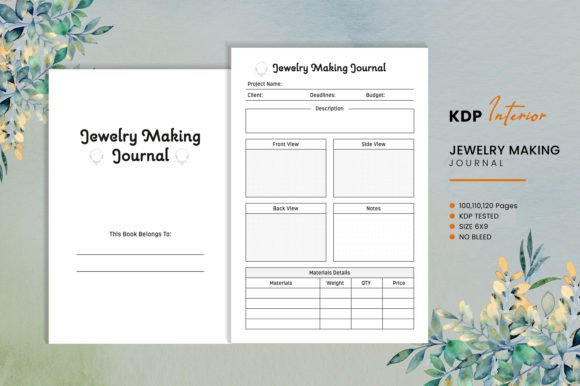
At its simplest, this is a pre-designed interior template built specifically for a journal targeted at jewelry makers. Unlike a generic lined notebook, it is structured with the needs of a jewelry enthusiast in mind—though the exact page layout should be examined closely in the product listing. The package typically includes a ready-to-upload PDF and an editable source file in EPS format. The provided trim size is 6 x 9 inches, a standard dimension that works well for hands-on craft journals. No bleed simplifies the upload and printing process, since page content doesn't extend to the edge. You can choose between 100, 110, or 120 pages, and the interior starts with a “Belongs To” page—a small touch that boosts the professional feel. All files are delivered in high resolution and have been tested specifically for Amazon KDP's requirements.
Why Publishers Are Drawn to This Type of Pre-Made Interior
The main attraction is straightforward: time savings. Designing a journal interior from scratch—setting margins, managing consistent headers or page numbers, testing for KDP’s print specifications—can easily eat up half a day, especially for publishers who aren't seasoned designers. A KDP-tested interior removes that friction. You can focus on creating a compelling cover, conducting keyword research, and listing the product. For many, this speed translates into a faster route to market, which matters if you're building a large catalog or responding to a trending niche like jewelry making.
Reliability also plays a role. KDP can be finicky about margins, fonts, and image placement. An interior that has already passed through KDP’s review process gives you confidence that the file won't be rejected for formatting issues. Add the availability of multiple page counts, and you gain flexibility to control the book’s spine width and perceived value without ever opening design software.
Key Features and What They Actually Mean for Your Project
Looking beyond the bullet points helps you gauge whether this product matches your publishing workflow and your customers' expectations. Here’s a breakdown of what each feature implies in practice:
- Ready-to-upload PDF – While this means you can go live in minutes, it also means you’re relying on the seller’s design choices. If the line spacing, page borders, or header style don’t align with your vision, you’ll need to tweak the source file.
- Editable EPS source file – This is a major plus for those who know Adobe Illustrator or similar vector software. You can change colors, replace graphics, or shift elements. If you lack those skills, however, the EPS adds no immediate benefit, and you may need to hire help to customize it.
- No bleed – Great for simplicity. You won’t need to factor in extra margin for trimming, and the interior will look clean. However, if you envisioned full-page decorative frames or illustrations that reach the paper’s edge, a no-bleed layout might feel too restrained.
- 6 x 9 inches trim size – This is widely adopted for craft and hobby journals. It feels substantial without being bulky, and KDP’s printing costs for this size are well-known. The only trade-off is that many competitors also use 6x9, so differentiation relies more on cover design and interior uniqueness.
- Choice of 100, 110, or 120 pages – This flexibility is useful. A 100-page journal can be priced as a budget option, while a 120-page version feels more premium. Just be aware that each page count results in a different production cost, affecting your royalty calculation.
- “Belongs To” page and high-resolution interiors – These small details elevate the user experience. Clear, crisp printing matters enormously for a journal where someone might sketch jewelry designs or note measurements.
- KDP tested – This reduces your risk of file rejection, which can be frustrating and delay your launch. But always preview the file in KDP’s print previewer anyway, since Amazon’s interpretation can sometimes shift with software updates.
When This Journal Interior Is a Strong Fit for Your Business
If you meet several of the following criteria, a pre-made Jewelry Making Journal KDP Interior could be a sensible investment:
- You are new to KDP publishing and want a low-risk way to launch your first product without learning complex design tools.
- You are building volume in the jewelry-making niche and need a reliable, repeatable interior format you can pair with multiple cover designs.
- Your priority is speed—perhaps you want to publish a journal to coincide with a seasonal demand spike or a trending craft technique.
- You have minimal or no graphic design experience, and the included EPS source file gives you just enough room to make small tweaks like adding a logo or changing a font.
- You view this interior as a stepping stone rather than a final destination; you plan to test the market first, then invest in custom interiors once you validate demand.
For these scenarios, the cost of the template is often negligible compared to the hours saved, and the peace of mind from a KDP-tested file can be invaluable.
Potential Trade-Offs to Consider Before Committing
No template fits every publishing strategy. Here are a few reasons why you might pause or seek alternatives:
- Limited uniqueness. If you’re one of many publishers using the same interior, your journal might look identical to other listings on the same search results page. In a crowded sub-niche, this sameness can push you toward competing primarily on price.
- Design constraints. Even with the EPS file, significant redesign could be time-consuming. If the structure does not already include specific sections—like project pages, material cost trackers, or sketch grids—you might find it hard to retrofit those elements without essentially rebuilding the file.
- Page count rigidness. The options are 100, 110, and 120 pages. If your ideal journal requires exactly 90 or 150 pages, you’d need to modify the source file extensively or accept a page count that feels slightly off for the intended use case.
- Software dependency. The EPS format requires a professional vector editing program. If you plan to make meaningful changes and don’t own such software, that’s an additional hidden cost.
Carefully comparing the interior’s actual layout against what you believe jewelry makers want—say, a mix of dot grid and lined sections, or dedicated space for gemstone notes—will help you judge whether the template meets those needs or just gives a generic journal a crafty name.
Customization: How Much Can You Really Change?
A key question for any Jewelry Making Journal KDP Interior purchase is how far the source file can take you. The EPS file allows you to adjust text styles, swap out decorative elements, reposition headers, or even change the overall motif. If you want to add a unique border inspired by filigree patterns, that’s within reach if you have the skills. However, deeper structural changes—like converting every other page into a dedicated sketch template—may require almost as much effort as starting from scratch. Think of the EPS as a starting framework, not a fully modular system. If your branding relies on a signature interior look, factor in the time (or designer expense) needed to make it truly yours.
Alternative Approaches: When a Custom or Different Interior Might Be Better
There are situations where bypassing a pre-made interior altogether makes more sense:
- You want to build a recognizable brand. A custom interior with unique page layouts, designed specifically for the type of jewelry making you focus on (beading, wire wrapping, resin casting), can become a hallmark of your publishing line.
- You are targeting a narrow sub-audience with very specific content. For instance, a journal for beaders might benefit from fully incorporated graph paper for pattern design. A pre-made interior may not offer that level of specialization.
- You have or can afford design expertise. If you already design your own interiors, buying a template may feel redundant. Instead, you could invest that money in premium assets or fonts to make your own creation stand out.
- You plan to sell the journal at a higher price point. Customers paying a premium often expect a more curated interior experience—something that would be difficult to achieve with a mass-market template.
Alternatives include hiring a freelancer to create a fully bespoke interior, using free but limited KDP interior tools, or purchasing a template bundle that offers more variation so you can mix and match page styles within a single book.
Practical Steps to Decide If This Interior Aligns With Your Goals
Before adding the Jewelry Making Journal KDP Interior to your cart, run through this quick evaluation:
- Analyze the competition. Search for “jewelry making journal” on Amazon. Look at the top 10 results. Do many of the interiors look similar? If the market already feels saturated with identical templates, a custom twist could give you an edge.
- Define your ideal customer. What would a jewelry maker actually need from a journal? If the template provides lined or blank pages without specialized prompts, would your buyer still find it useful, or would they skip to a more tailored option?
- Assess your skills and resources. If you can confidently open and edit the EPS file, the template’s value multiplies. If not, gauge the realistic cost of asking a designer to personalize it.
- Plan for the long term. Even if you start with this interior now, how easily could you later transition to a custom version without confusing repeat customers? A pre-made interior can be a great launchpad, but only if it fits into a broader product roadmap.
- Calculate time-cost trade-offs. If buying this interior saves you five hours of work, and your time is better spent on marketing or cover design, the purchase might be justified even if the end result is not entirely unique.
Balancing Speed and Originality in Low-Content Publishing
The Jewelry Making Journal KDP Interior represents a practical tool in a self-publisher’s kit. It’s built by someone who understands KDP’s technical demands, and the inclusion of an editable source file puts a degree of control in your hands. For those entering the jewelry making niche, or for experienced publishers who need to scale quickly, the interior can serve as a dependable foundation.
That said, no single template can cater to every creative vision. A journal that resonates with a buyer goes beyond having a pretty cover—it needs an interior that feels like it was made for the craft, not just given a craft-themed name. Weigh how much originality matters to your brand against the very real advantages of speed and reliability. If you lean toward customization and long-term brand building, view this interior as a springboard, not a permanent fixture. But if your immediate goal is to publish a solid, KDP-safe journal with minimal friction, then this ready-to-upload solution might be exactly what your business needs right now.