Reading Logbook Journal Version‑2: A Practical Evaluation for Self‑Publishers and Avid Readers
When evaluating low‑content book interiors for Kindle Direct Publishing, the sheer number of templates available can make the choice feel overwhelming. Among these options, the Reading Logbook Journal Version‑2 surfaces as a purpose‑built interior aimed squarely at reading trackers, book journals, and literary organizers. This article examines what the product actually includes, the situations where it shines, and the tradeoffs a creator or an end user might need to weigh before deciding if it matches their project goals.
What the Package Contains
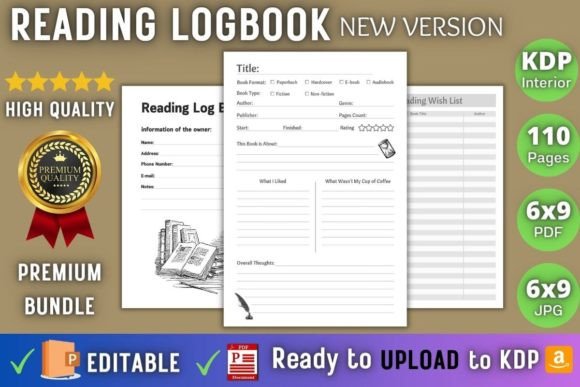
Unlike a design concept sold only as a flat preview, the Reading Logbook Journal Version‑2 arrives as a collection of deliverables intended for immediate use on KDP. Understanding these components helps set realistic expectations for what you’re buying:
- A print‑ready PDF file formatted at 6×9 inches with full bleed
- JPG images of each page, useful for mockups, marketing, or verifying the layout
- 110 pages of interior content, including a personal “Belongs To” page
- Files explicitly tested on KDP, meaning margins, bleed zones, and safe areas have been validated for Amazon’s printing process
The presence of a tested PDF removes a significant friction point—guessing whether a file will pass KDP’s automated checks. Including bleed is also a practical detail; many printing mishaps stem from white slivers at the edge, and a bleed‑ready document minimizes that risk.
Who Finds This Product Useful
Two distinct audiences intersect around a product like the Reading Logbook Journal Version‑2. The first is KDP publishers who want to expand their catalog with a reading logbook but lack either the time or the design expertise to create an interior from scratch. For them, a pre‑made interior turns a weeks‑long process into a matter of hours—simply pair it with a cover and the book is essentially ready to list.
The second audience is the end reader who might buy the finished journal on Amazon. They are often looking for a structured space to record titles, authors, dates, ratings, and reflections. A thoughtfully laid‑out reading log can replace scattered sticky notes and smartphone notes with a single, guilt‑inducing paper trail of everything they have read or plan to read. Because the interior is designed as a journal rather than a notepad, it encourages consistency and preserves memories in a way that digital lists sometimes fail to do.
Strengths That Address Real Publishing Frictions
One of the most understated strengths is the ready‑to‑upload nature of the PDF. KDP’s print‑on‑demand system is exacting, and a file that has already been tested reduces the chance of rejections or customer complaints about flawed trim. That reliability alone can justify the purchase for a publisher operating on thin margins where every return hurts.
The choice of 6×9 inches with bleed also aligns with reader expectations. This trim size is a workhorse for trade paperbacks and journals; it feels substantial in the hand but is not too bulky for a tote bag. The 110‑page count strikes a balance between giving enough room for an entire year of reading and keeping the spine thin enough for a lay‑flat design. A “Belongs To” page subtly elevates the book, making it feel personal and gift‑worthy rather than generic.
Another practical advantage is the inclusion of JPG images. Many designers overlook how useful page images can be: they help craft a compelling Amazon listing, allow for quick visual checks without opening large PDFs, and serve as assets for social media promotion.
Tradeoffs and Situations Where Alternatives Deserve a Look
No template is without constraints, and honest evaluation requires examining the compromises baked into the Reading Logbook Journal Version‑2.
Fixed Page Count and Template Rigidity
At 110 pages, the logbook fits a specific narrative—perhaps a year of reading for a moderate‑pace reader. A voracious reader who finishes two books a week may fill those pages in half the time, making the journal feel short‑lived. Conversely, a publisher targeting a minimalist audience might want a slimmer, 60‑page version. Since the PDF is not provided as an editable source file (no InDesign or Affinity Publisher template is mentioned), altering the page count or rearranging sections would require manual extraction and reflow, which is rarely straightforward. Those who value complete control over sequencing may need to look for interiors delivered with editable source files, or build one from scratch using tools like Canva or Book Bolt.
Design Uniqueness and Branding
The product is described as having a “NEW pages design,” but without seeing the full interior, the degree of originality remains an assumption. If the logbook pages follow a common layout—title, author, date, rating, notes—then it will compete with numerous similar journals on Amazon. For a publisher looking to stand out in a crowded niche, a template alone won’t create differentiation. The cover becomes the magnet, but the interior design still shapes repeat purchases and reviews. A publisher with strong branding might find the interior too neutral; someone wanting a heavily illustrated or themed reading journal (e.g., celestial, botanical, vintage library) will need to evaluate whether this design aligns with that aesthetic or whether a more customizable solution from a designer marketplace would be wiser.
Editing Limitations
Modifying a flattened PDF—even just to add a page or change a font—can introduce unexpected issues. Text may not reflow correctly, and bleed margins might shift. The JPG files offer a fallback for visual editing, but reassembling them into a print‑ready PDF with proper resolution, trim, and bleed is a technical task that demands software like Adobe Acrobat or Photoshop. Beginners who expect to tweak the design extensively might be better served by an interior that explicitly grants editing rights with vector‑based source files.
When the Reading Logbook Journal Version‑2 Aligns Well With Your Project
Despite the limitations, several scenarios make this interior a logical choice:
- First‑time KDP publisher: The learning curve around bleed, margins, and file format is real. Using a tested template allows you to focus on cover design and keyword research instead of troubleshooting a PDF that Amazon rejected.
- Speed to market: If you identify a trending interest in reading journals—perhaps tied to a new book launch or a social media reading challenge—the ability to go from purchase to publish within a day carries tangible advantage.
- Gift‑oriented product: The “Belongs To” page and uniform layout make it easy to position as a thoughtful present for bibliophiles. The simplicity communicates reliability, not noise.
- Complementary product line: If you already sell reading‑related items—bookmarks, reading lights, bookplates—a straightforward reading log fills a natural gap without overcomplicating your brand.
Decision Factors for the End Reader
From the perspective of someone buying the finished journal on Amazon, the evaluation shifts slightly. A reading logbook serves not just as a repository but as a companion that influences the reading habit itself. Key questions include: Does the layout encourage daily entries without feeling like homework? Are the rating scales intuitive? Is there adequate space for notes beside the mandatory fields? The Reading Logbook Journal Version‑2 aims for a clean, uncluttered space, which suits readers who dislike visual noise but might disappoint those who enjoy decorative elements, prompts, or color‑coded systems. The 6×9 size is easy to manage, but a larger format (such as 8×10) might appeal to readers who write lengthy reviews. Understanding the end user’s preferences matters as much as the publisher’s convenience.
Comparing the Ready‑Made Route to Other Approaches
Choosing a pre‑designed interior sits on a spectrum. At one end is the fully custom design, where a freelancer or agency builds a journal tailored to exact specifications. That path guarantees uniqueness but demands a higher budget and longer turnaround. At the opposite end is the do‑it‑yourself option with free or low‑cost software; it offers ultimate control but consumes time and often leads to amateur mistakes in bleed, gutter, and resolution. The Reading Logbook Journal Version‑2 occupies the middle: you trade design exclusivity and deep editability for reliability and speed. For many KDP publishers, this tradeoff is not a drawback but a deliberate strategic choice. The same logic applies to a reader who might buy the published book: they accept a template‑based layout in exchange for a proven structure that has already been validated by KDP testing.
Practical Insights Beyond the Spec Sheet
Several factors that aren’t usually printed on a product description can influence the purchasing decision:
- Bleed integrity: A design with bleed means backgrounds and images extend beyond the trim line, so final cuts don’t show white edges. This is non‑negotiable for a polished product.
- PDF weight and printability: A heavy file can cause sluggish performance during upload or proofing. While not specified, a well‑optimized PDF for 110 pages should hover under 30 MB—something to verify after download.
- Page numbering and consistency: A logbook that repeats the same layout on every page is easier to print, but subtle errors like shifting text boxes from page to page can sneak in. Pre‑tested files reduce that worry.
- Resale and licensing clarity: The product is sold for KDP use, implying commercial rights, but anyone purchasing should confirm the license terms—specifically whether it allows use in multiple books or is limited to a single project.
Making the Right Choice for Your Goals
Evaluating the Reading Logbook Journal Version‑2 eventually circles back to a simple question: what is the biggest obstacle you face right now? If it’s the technical hurdle of creating a print‑perfect interior, this template offers a meaningful shortcut. If it’s market saturation, you will still need to invest in a distinctive cover and smart keyword targeting. If your audience demands a highly specific layout—reading challenges, top‑ten lists, or genre‑specific sections—then the fixed structure might restrict you more than it helps.
In practical terms, the package meets most technical checkboxes: KDP‑tested, correct trim, bleed included, and a familiar page count. Its value, however, is not absolved from context. A publisher who treats it as a starting point rather than a final statement will likely extract more benefit than one who simply wraps a cover around it and hopes for sales. The same caution applies to the eventual reader; a journal is only as useful as the habit it fosters. A clean, well‑constructed interior supports that habit without demanding attention for itself.
For those still uncertain, comparing the sample images (if available on the designer’s page) against other reading logbook interiors on Amazon can clarify whether the visual tone matches the audience you aim to serve. No template can guarantee success, but the right foundation removes friction, and that alone can tip the scales in a crowded marketplace.