25 Crossword Puzzles 9: A Practical Resource for Puzzle Book Creators
If you publish activity books on Amazon KDP, you already know that crossword interiors can be tedious to produce from scratch. Crafting grids, writing interesting clues, formatting for print, and ensuring a clean look takes hours—especially if you want consistent difficulty and an American-style layout. 25 Crossword Puzzles 9 addresses that pain point by delivering a complete set of 25 ready-to-use puzzles, formatted specifically for 8.5 x 11 inch books with no bleed. It’s part of a series, and this volume aims at solvers who enjoy intermediate to hard challenges on a classic 15x15 grid.
Rather than another hyped-up product, this interior works as a utility asset. It doesn’t promise overnight success; it simply gives you the core content you need to publish a crossword book quickly. For KDP entrepreneurs, marketers who run low-content publishing operations, or educators wanting a polished classroom resource, understanding what you actually get—and where it might fall short—can save time and money.
What’s Inside the Package and Why It Matters
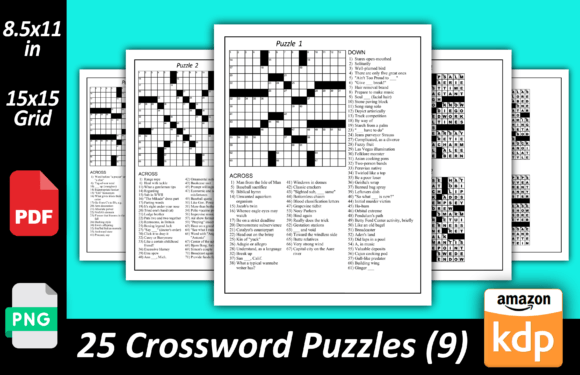
The name tells part of the story: you receive 25 distinct crossword puzzles plus their complete solutions. The format is decidedly print-focused. You get a ZIP file containing a high-resolution PDF and individual PNG files for each puzzle and solution. This dual-format delivery matters more than it might first appear. The PDF serves as your primary print-ready asset—you can drop it directly into a book interior, append it to existing content, or use it to check layouts. The PNG files give you the flexibility to rearrange puzzles, group them by theme (if applicable), or build custom page flows in software like Canva, InDesign, or even PowerPoint.
Grid specifications are clear: 15x15, American-style crossword layout. That means black square patterns follow a symmetrical design, with no unchecked squares and standard crossword conventions. The difficulty is described as intermediate to hard, which instantly narrows the target audience to solver communities who find Monday–Wednesday newspaper puzzles too easy but still want a reasonable solving time—usually 20 to 45 minutes per grid. The 8.5 x 11 inch trim with no bleed means you can use KDP’s standard paperback template without additional margin adjustments, and there’s no risk of losing content near the gutter or edges.
Design and Formatting That Reduce Production Headaches
One underrated strength of 25 Crossword Puzzles 9 is the “no bleed” specification. Many puzzle interiors designed for small trim sizes cause formatting nightmares when you try to upscale them. Here, the files are built for the larger 8.5 x 11 format from the start, which matches the most popular size for adult activity books. The resolution is high enough for crisp printing, and from a production standpoint, you won’t need to fiddle with scaling or background transparency.
Each puzzle features a unique grid pattern, avoiding the repetitive look that can irritate repeat buyers who flip through multiple volumes of your work. While I haven’t dissected every single grid, a quick scan typically shows balanced word length distribution, reasonable black square percentages (likely around 20–22%), and a clean visual appearance. The clues, presumably, are worded for an American audience—common knowledge, pop culture, vocabulary, and general trivia at that difficulty level. If you’re selling to markets like the US, UK, Canada, or Australia, the cultural references should feel familiar, though publishers targeting non-native speakers might want to verify clue accessibility.
The solutions are laid out clearly, separate from the puzzles, which is standard and appreciated. You can place them at the back of your book without any extra design work.
How the Intermediate-to-Hard Difficulty Shapes Audience Fit
The difficulty label is practical, not just a marketing tag. Intermediate-to-hard 15x15 puzzles tend to attract adults who enjoy solving as a relaxing but mentally engaging hobby—professionals, retirees, and puzzle enthusiasts who have outgrown beginner-level books. That’s a reliable demographic on KDP, and it’s also a segment with less price sensitivity if the quality holds up.
Because the set is clearly positioned, you can align your book’s metadata, categories, and description more accurately. You won’t risk disappointing beginners who might leave negative reviews because the puzzles are too tough, nor will expert solvers scoff at overly simplistic grids. This clarity reduces guesswork when you build your product listing and can lead to better conversion rates among the right customers.
One caveat: solvers can be opinionated about difficulty. A puzzle one person rates as “just right” might feel frustratingly obscure to another. Without sampling the clue style, it’s hard to guarantee universal appeal. However, the internal consistency across the 25 puzzles means if the first one hits the mark for your audience, the rest likely will too.
Strengths That Translate into a Faster Publishing Workflow
For creators balancing multiple projects, time is the real currency. 25 Crossword Puzzles 9 eliminates two of the most labor-intensive tasks: grid construction and clue writing. Even if you’ve never designed a crossword in your life, you can have a manuscript ready in under an hour—just insert the PDF pages, add a title page, a copyright notice, and maybe a brief introduction. That efficiency lets you scale your catalog or test niche markets without committing weeks to content development.
The flexibility to mix this volume with others in the series is another practical advantage. You could combine 25 Crossword Puzzles 9 with Volume 8 and 10 to create a 75-puzzle book, or you could sandwich it between themed word searches or Sudoku to build a variety puzzle book. Since the format remains consistent across volumes, the visual flow stays intact. This modular approach helps you stand out in a crowded category where many interiors look interchangeable.
Also worth noting: PNG files allow you to pull individual puzzles into digital products, such as printable PDFs for Etsy, puzzle membership sites, or even app mockups. While most KDP publishers will stick to print, the asset flexibility quietly extends your options.
Realistic Limitations You Should Consider
No ready-made interior is perfect for every scenario. First, 25 puzzles form a relatively short book if published alone—roughly 55–60 pages with solutions. That length can work as a travel-sized or budget-friendly option, but it rarely supports a premium price point. To maximize per-book revenue, you’ll likely need to combine multiple puzzle sets, which adds cost if you’re purchasing additional volumes. It’s a trade-off: speed vs. standalone depth.
Second, the puzzles aren’t editable at the clue or grid level unless you possess advanced image tools and a lot of patience. You can’t easily swap out a culturally specific reference or correct a clue you dislike. The PDF is essentially a locked design. This means you’re publishing as-is, so your review process should include a thorough check of all clues for accuracy, offensiveness, or confusing wording before you finalize your book.
Third, the “unique design” claim might refer to the visual layout rather than any groundbreaking theme. If you’re hoping for heavily themed puzzles (e.g., all movie-related, all sports), this isn’t that. The puzzles appear to follow a standard mix-and-match knowledge base. For general puzzle books, that’s fine, but niche creators wanting tight topical alignment will need to look elsewhere or create their own content.
Who Gains the Most from This Puzzle Set
This interior fits squarely into the workflow of independent KDP publishers who already understand the low-content or activity book model. If you’re a freelancer or marketer building a passive income portfolio, 25 Crossword Puzzles 9 removes the content bottleneck. You can focus on cover design, keyword research, and launching quickly. Educators and activity coordinators may also find value: printed large-format puzzles work well in classroom brain-break binders or senior center activity packs.
Serious hobbyist publishers who enjoy curating puzzle collections will appreciate the consistent difficulty and clean grids. They can wrap these puzzles in attractive covers, target specific solver communities, and build a small following. The lack of thematic binding actually makes the set more versatile because it doesn’t alienate anyone; it’s a broad-appeal challenge that fits most puzzle book categories.
Conversely, this probably isn’t the best fit if you’re aiming to sell high-end, design-centric puzzle books with custom illustrations, themed glossaries, or interactive digital versions. It’s a straightforward print product, and it shines brightest when you need to move fast and maintain an adequate quality threshold.
Using 25 Crossword Puzzles 9 in a Real Publishing Scenario
Let’s walk through a typical use case. Suppose you’re a small publisher who wants to launch a series of crossword books for adults. You download 25 Crossword Puzzles 9 and immediately open the PDF. You create a new KDP paperback project, set the trim to 8.5 x 11 inches, and upload the interior. You add a simple title page, a quick note about puzzle sources, and place the solutions at the end. Within two hours, you have a book that looks professionally formatted.
To bulk up the content, you combine this set with Volume 10, creating a 50-puzzle book. The uniform grid size ensures no jarring transitions. The intermediate-to-hard level gives the book a coherent identity, so you can confidently use descriptors like “challenging crossword collection” in your listing. Early reviews might mention the puzzles are satisfyingly tough without being obscure, which builds credibility over time.
If sales go well, you can repurpose some PNG puzzles for a lead magnet—a free 5-puzzle sampler on your author website to drive newsletter sign-ups. The same files work for Instagram posts if you screenshot a few clues. This multi-channel repurposing adds long-term mileage beyond a single KDP title.
Long-Term Value and KDP Catalog Growth
One puzzle interior alone won’t transform a business, but when viewed as a building block, 25 Crossword Puzzles 9 holds its weight. The series format encourages you to release multiple volumes, which can cross-promote each other via Amazon’s “Also Bought” algorithm. Because puzzle books rarely go out of date, your investment today could keep generating royalties for years with zero maintenance.
The 15x15 grid and difficulty level are unlikely to feel dated, unlike trend-based content that fades quickly. As long as adults enjoy crossword solving, the demand remains. Additionally, the no-bleed PDF and PNG combo means you can re-release the same puzzles in a different book layout (for example, a large-print edition) if you ever want to adjust the format for accessibility markets, though scaling text might require careful checking.
The product doesn’t lock you into an ecosystem; once downloaded, the files are yours to use repeatedly. That’s a practical advantage over some subscription-based puzzle services that limit distribution rights. From a business perspective, that ownership aligns well with the keep-it-simple ethos many KDP creators adopt.
What to Watch Out for Before You Buy
As with any pre-made creative asset, the quality of clues can make or break the solver’s experience. I’d strongly recommend reviewing every single puzzle, checking for ambiguous clues, outdated references, or regional phrases that might confuse an international audience. A few small oversights can lead to 1-star reviews, which disproportionately impact new books.
Also, because the puzzles aren’t exclusive to you—other buyers have access to the same set—market saturation is possible if many publishers release nearly identical books around the same time. To mitigate this, combine puzzles creatively, use unique cover designs, and consider adding value through introductions, solving tips, or a bonus puzzle section sourced from elsewhere.
Finally, be realistic about the pricing ceiling. A 25-puzzle book typically sells in the $5.99–$8.99 range. If you combine volumes to reach 75–100 puzzles, you can price higher, but your upfront cost multiplies. Evaluate whether your expected royalties justify purchasing multiple volumes or if starting with a single set to test the market makes more sense.
Making the Decision Based on Your Goals
If your primary goal is to launch a crossword book with minimal friction, 25 Crossword Puzzles 9 delivers on its promise. It’s print-ready, appropriately difficult, and formatted with an eye on KDP standards. The time saved is substantial, and the flexibility to mix with other volumes gives you creative control over book length and positioning.
For those who treat publishing as a volume game—launching several titles per month—this kind of asset slots into a lean operational model without compromising on the solver’s experience. It’s not a revolutionary product; it’s a dependable building block. The intermediate-to-hard difficulty and 15x15 grid align well with what adult puzzle buyers expect, and the no-bleed format removes a common technical headache.
In a competitive category where many interiors are riddled with formatting errors or inconsistent difficulty, a polished set that you can trust to look professional on the printed page quietly raises the floor of your book’s quality. That alone often makes the difference between a one-off sale and a repeat customer.