Word Search Puzzle Book Interior for KDP: A Publisher’s Guide
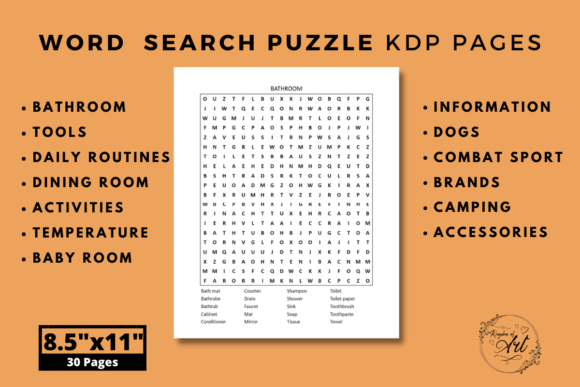
Creating a word search puzzle book that’s truly ready for Kindle Direct Publishing doesn’t have to mean wrestling with formatting or starting from a blank page. A purpose-built Word Search Puzzle Book Interior for KDP gives you the exact structure you need — properly sized pages, clean typography, and a black-on-white finish that prints reliably at home or through professional print-on-demand services. What sets a high-quality interior apart is not just the puzzle content, but the thoughtful layout that works for real solvers. The 30 pages of puzzles and solutions, the ample 8.5 x 11-inch trim, and a no-bleed design all speak to a product that values both user experience and publishing efficiency.
What You Actually Get With a KDP-Ready Puzzle Interior
These interiors are typically delivered as a ready-to-print PDF coupled with an editable source file. The puzzles draw from varied themes like Tools, Gems, Dogs, and more — a smart approach that appeals to different audiences without forcing you to build niche content from scratch. Each puzzle page includes a word list and a letter grid where words can hide horizontally, vertically, diagonally, and sometimes backwards. Solutions are provided on separate pages or conveniently placed, eliminating guesswork for any creator who wants to jump into publishing immediately.
- Page size: 8.5 x 11 inches, the standard for North American puzzle books. Large enough for clear lettering, yet familiar to home printers.
- Black ink on white paper: Keeps printing costs low, which translates directly into better royalty margins on KDP or lower production costs for bulk orders.
- No bleed: All content stays well within the trim area. You won’t lose part of a word list or solution edge, making this interior accessible even for first-time self-publishers.
- Editable file included: Whether the source file is in a common format like PowerPoint, Canva, or InDesign, you gain the power to tweak puzzles, change category names, or add your own branding.
Why Publishers and Creators Prefer Pre-Designed Interiors
Speed and professionalism are the twin pillars here. Instead of spending hours aligning grids and checking margins, you import the file, make minor customizations, and upload. The 8.5 x 11 format is a workhorse trim on KDP — it allows for larger fonts that appeal to adults and seniors, while still feeling substantial in the hands of younger solvers. Because the design is no-bleed, there’s far less risk of file rejection during KDP’s automated review. For someone running a micro publishing business, that reliability means you can push out multiple titles across different themes — Word Search for Dog Lovers, Gems and Minerals Puzzle Book, Tool Time Brain Games — all from the same base interior, simply by swapping the editable content.
The Editable File Opens a World of Customization
An interior that arrives locked as a flat PDF is helpful, but an interior that arrives with an editable file is a strategic asset. You can transform the word search puzzle book interior for KDP into a fully branded product. Add your logo, insert a QR code that leads to your newsletter, or rewrite the word lists to reflect local slang, industry jargon, or classroom vocabulary. A financial literacy coach, for instance, could adjust a “Tools” themed puzzle into “Investment Terms.” An animal shelter might recolor a few design elements and sell a “Rescue Dogs Word Search” to raise funds. This flexibility means you aren’t buying a puzzle book — you’re buying a publishing framework that can serve multiple commercial, educational, or personal goals.
Practical Applications Across Personal, Professional, and Educational Environments
The value of a well-structured puzzle interior extends far beyond simple entertainment. Here’s how different groups put it to use:
- KDP authors and low-content publishers: Quickly launch activity books that complement existing no-content or low-content lines, from journals to coloring books. A 30-page puzzle book is lightweight enough to be priced competitively while still feeling complete.
- Educators and tutors: Use the interior as a master template for warm-up exercises, spelling practice, or vocabulary reinforcement. The large 8.5 x 11 pages are easy to photocopy for classroom distribution.
- Health and wellness professionals: Occupational therapists and senior care coordinators give single-page puzzles to clients as cognitive stimulation. The clean, high-contrast design reduces visual fatigue, which is important for older adults.
- Entrepreneurs and marketers: Create a custom branded puzzle book as a lead magnet or client appreciation gift. Because you can swap thematic elements, a real estate agent might craft a “Home & Garden Word Search,” while a software team might create a “Coding Terms” version — all from the same core file.
- Families and hobbyists: Print and bind a personalized road trip activity book or a unique gift for a puzzle-loving relative. The ability to edit means you can even hide names or inside jokes within the word lists.
Design Choices That Influence Usability and Reader Satisfaction
Good puzzle book design is invisible — it simply works. Several features of this interior directly support a better solving experience:
Ample whitespace: The 8.5 x 11 page with no-bleed content ensures generous margins. Solvers can hold the book comfortably without obscuring any clues, and there’s room to circle words without bleeding into the binding area.
High-contrast readability: Black ink on white paper delivers crisp letters. There’s no color code to decode; the straightforward presentation means the puzzle can be enjoyed by anyone regardless of visual acuity, provided they use reading glasses if needed.
Logical solution placement: Solutions are either positioned on the reverse side or gathered at the end of the book. This prevents accidental glances and keeps the challenge intact. When you purchase the editable file, you can rearrange solution pages to suit your preference — for example, placing answers directly after each puzzle for an easier self-checking format.
Theme variety: The inclusion of multiple categories like Tools, Gems, and Dogs keeps the solver engaged. It also makes the book feel more dynamic than a single-topic collection. From a publishing standpoint, that variety supports better searchability on Amazon when you list the book under relevant categories.
Getting the Most Out of Your Word Search Puzzle Book Interior for KDP
Before you hit publish, consider a few real-world steps that can amplify the finished product’s appeal:
- Open the editable file in your preferred software and immediately save a copy with your own branding elements. Even a small logo on each solution page adds a professional touch.
- Tailor at least one puzzle theme to your exact niche. If you’re targeting gardening enthusiasts, rename “Tools” word lists with gardening-specific terms like trowel, compost, and perennials.
- Test-print a handful of pages on standard 8.5 x 11 paper. Check that letters are bold enough, margins are even, and the solution grid aligns correctly. This simple step prevents returns and negative reviews.
- If you plan to sell on Amazon KDP, remember that the paperback minimum page count is 24. With 30 pages of puzzles and solutions, you’re safely above that threshold. Adjust the page count in your KDP metadata accordingly.
- Look at the big picture: A word search puzzle book interior for KDP is a low-content product, but its packaging matters immensely. Pair this interior with a professionally designed cover that clearly signals the theme, and you’ve got a product that can stand alongside books from major publishers.
Real-World Publishing Scenario
Imagine a freelance graphic designer who wants to build a passive income stream. They purchase this interior file, spend one afternoon customizing the covers for three variations — Dogs, Gems, and Tools — using the editable source file to swap a few graphics and word lists. By evening, they upload all three books to KDP. Each title is priced at $8.99. Over the next month, they sell a combined 40 copies. That’s not a lottery win, but it’s a repeatable process that requires no inventory, no shipping, and minimal ongoing effort. The ability to edit and re-skin the same high-quality interior commoditizes the hardest part of low-content publishing: the interior layout.
What to Look for When Evaluating a Puzzle Book Interior
Not all interiors are created equal. Before you purchase or download a word search puzzle book interior for KDP, ask yourself a few practical questions:
- Does the editable file work with software I already own? Common formats include PPTX, Canva links, or INDD/IDML. If you don’t have a particular program, you might need to invest or find a compatible alternative.
- Are the puzzle grids algorithmically generated or manually crafted? Automatically generated puzzles can sometimes produce unusual letter combinations that look messy. A well-vetted interior will have clean, human-checked grids.
- Is the page count exact? Some interiors count a page with both a puzzle and its solution as one page, while others count each side separately. Clarify upfront to avoid running into KDP’s page-count rules.
- Does the license allow commercial use? If you plan to sell the finished puzzle books, confirm that the interior includes commercial rights. Most priced interiors sold specifically for KDP do, but it’s worth checking.
- How much design flexibility do you need? If you only want to change a logo and a few words, an editable PDF in Canva might be perfect. If you want total layout control, a fully layered source file is the better choice.
The strongest asset of this kind of product is its simplicity. By starting with a properly formatted word search puzzle book interior for KDP, you bypass the formatting bottlenecks that stall many creative projects. Whether you’re a seasoned publisher building out a catalog, a teacher looking for a reusable resource, or a business owner wanting a unique promotional item, that ready-to-go framework gives you more time to focus on what you do best — connecting with your audience and delivering value.