Mastering Equipment Reliability with a Structured Maintenance Log Book
Every piece of machinery, from a household lawnmower to a fleet of industrial generators, depends on regular attention to function safely and efficiently. An Equipment Maintenance Log Book serves as the central record for that attention. It is far more than a simple notebook; it is a strategic tool that transforms sporadic fixes into a planned, predictable, and cost-effective system. Whether you manage a construction site, run a commercial kitchen, or simply want to extend the life of your personal tools, adopting a consistent logging practice is one of the most impactful decisions you can make.
Understanding the Equipment Maintenance Log Book
At its core, an Equipment Maintenance Log Book is a dedicated document where you track every service event, inspection, repair, and part replacement for a specific asset. Think of it as a health journal for your equipment. Each entry captures the date, the action taken, who performed it, and any notes about the item's condition. This is not a form to fill out once and forget. Its real value emerges over weeks and months as data accumulate, revealing patterns that help you anticipate failures before they happen. For a small business, this might mean the difference between a quick lunch-rush repair and a catastrophic oven failure that halts operations for days. For a homeowner, it could be simply remembering when you last changed the mower oil, avoiding costly engine damage.
The concept is rooted in preventive maintenance. Instead of waiting for a breakdown, you schedule tasks based on usage or time intervals. The log book enforces that discipline. It takes a vague good intention—“I should check the hydraulic fluid sometime”—and turns it into a specific, accountable event. When you fill in the pages of an Equipment Maintenance Log Book, you create a defensible history that supports warranty claims, insurance assessments, and resale value. You also build a knowledge base for anyone who takes over the equipment’s care in the future.
Why Consistency in Record-Keeping Matters
Many equipment failures share a common root cause: inconsistent or forgotten maintenance. A single missed greasing point on a loader can lead to accelerated pin wear, a five-figure repair, and days of downtime. A log book transforms these invisible oversights into visible, actionable items. When every inspection, fluid top-up, and belt change is recorded, you gain a reliable timeline. You begin to see that a certain conveyor bearing needs replacement every 400 operating hours, or that a specific pump starts losing pressure at the 12-month mark. This data lets you order parts in advance and schedule work during planned shutdowns, not during emergencies.
Beyond the mechanical benefits, an Equipment Maintenance Log Book is a communication tool. In a shop with multiple technicians, it prevents duplication of effort and clarifies who did what. A morning handover note in the log can save an afternoon of troubleshooting. For managers, it provides a clear picture of recurring issues, labor allocation, and maybe even reveal that a particular brand of replacement part is failing prematurely. The log becomes a single source of truth, reducing confusion and building a culture of accountability.
Who Benefits from a Detailed Logging Practice?
The applications are remarkably broad. A facility manager uses a log to stay compliant with safety regulations and insurance stipulations, documenting fire suppression system tests and elevator inspections. A small fleet owner tracks oil changes, tire rotations, and brake inspections across multiple vehicles, optimizing resale timing and minimizing roadside breakdowns. In a rental business, the log book travels with the equipment, giving each renter proof of the machine’s upkeep and setting clear expectations about responsible use. A serious hobbyist or homesteader might keep a log for tractors, generators, and chainsaws, ensuring nothing is overlooked when seasonal demands peak.
Even landlords and property managers can apply the same principle to building systems—boilers, air conditioning units, sump pumps—logging maintenance to avoid tenant complaints and protect long-term property value. For any of these users, the approach shifts slightly. A hotel maintenance team might prioritize guest-impacting equipment like ice machines and elevators. A machine shop will focus on CNC tools and compressors. Yet the underlying need is identical: a clear, chronological record that anyone can reference.
Key Details Your Log Book Should Capture
A well-designed Equipment Maintenance Log Book balances simplicity with enough detail to be truly useful. While specific needs vary, most entries benefit from including the following elements:
- Date and time of the activity.
- Equipment identifier such as model, serial number, or asset tag.
- Odometer or hour meter reading to track usage-based schedules.
- Type of maintenance (inspection, preventive, repair, emergency).
- Specific tasks completed, parts used, fluids added.
- Observations on condition, unusual noises, leaks, or wear.
- Technician or operator name and signature.
- Next service due date or hours.
Pages that include these fields as clear, fillable sections encourage thoroughness. When a log book is bare or unstructured, entries often devolve into illegible scribbles that lose all value. A structured layout removes guesswork and makes data retrieval fast.
Real-World Applications and Outcomes
Consider a landscaping company with a dozen zero-turn mowers. Without a log, one crew might keep running a mower with dull blades and low oil, while another over-greases everything and wastes supplies. By implementing one centralized Equipment Maintenance Log Book per mower, the owner can look at a Tuesday morning and quickly see which units have had their weekly blade sharpening and which are overdue. The result is not just longer mower life, but a more uniform cut quality that keeps clients happy.
In a food processing plant, a log book might track the washdown and sanitation of a slicer. A skipped entry signals a potential food safety risk. The log then serves a compliance function, showing auditors a continuous record of due diligence. The combination of operational reliability and regulatory peace of mind is powerful.
A homeowner with a backup generator might only use it twice a year, but when a storm hits, they need confidence it will start. An annual log entry showing fuel stabilizer added, battery voltage checked, and a test run completed removes the anxiety. If the generator ever needs warranty repair, the manufacturer will likely ask to see maintenance records. A simple log book can be the difference between a covered repair and an out-of-pocket expense.
Designing a Log That Works for You
For many, the ideal Equipment Maintenance Log Book is a physical, bound book that stays with the machine. It requires no power, is immune to software glitches, and has a tactile immediacy that many technicians prefer. The key dimensions often fall around 6x9 inches—a size that is large enough to write in easily yet compact enough to toss in a glove box, tool chest, or job folder. A no-bleed interior layout ensures that every page has a clean margin, preventing important notes from being lost in the gutter during printing or binding.
When creating your own log book, whether for a single piece of equipment or a fleet, you want something that is print-ready and visually clean. A typical dedicated log book might have 120 pages, which strikes a balance between a long service life and a manageable thickness. High-resolution interiors guarantee that text and ruled lines are crisp, reducing eye strain during use. If you intend to share the log with colleagues or customers, having a uniform, professional layout reinforces the perception of care and competence.
Some users may prefer a digital approach, scanning QR codes that pull up maintenance history on a tablet. But the majority still rely on pen and paper for its instant accessibility and zero training requirements. The most effective log books blend the best of both worlds: a standardized physical record that can later be digitized or summarized for reports.
Bringing a Ready-Made Log Book to Your Workshop or Business
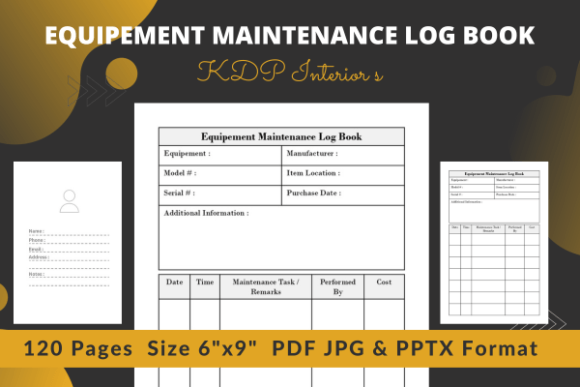
If you want to skip the hassle of designing layouts and worrying about print specifications, a pre-formatted solution can be a game-changer. For instance, a comprehensive Equipment Maintenance Log Book interior template, structured specifically for self-publishing on Amazon KDP or printing for personal use, gives you a professional foundation in minutes. That template includes 120 pages of thoughtfully organized entry fields, built to a 6x9-inch size with no bleed, so it’s ready for any standard printer. The files are provided in PDF, JPG, and even editable PPTX formats, which means you can add your company logo, adjust column headers, or tailor the wording to your exact industry. Because the PDF is already formatted and tested for KDP upload, you can publish a clean, high-resolution log book under your own brand without ever touching a design tool.
This approach isn’t just for commercial enterprises. A homeowner who wants multiple log books for a tractor, a generator, and an HVAC system can print just the pages they need and bind them simply. The editable PowerPoint file allows for deep customization—you might change “Equipment ID” to “Trailer VIN” for a haulage operation, or add a section for refrigerant type on an HVAC log. The asset starts as a collection of print-ready files, but it becomes whatever you require.
Remember, the interior files are designed to be the foundation; you will create your own cover to suit your brand or personal taste. This gives you complete control over the final product’s appearance while ensuring the inside is functional and compliant with printing standards. High-resolution, 100% editable, and built for a perfect KDP upload experience, a ready-made Equipment Maintenance Log Book template can cut design time to almost zero and put your focus back where it belongs: on maintaining your equipment, not designing your paperwork.
Adopting a disciplined maintenance log is an investment in peace of mind, safety, and financial efficiency. Whether you are tracking a single crucial asset or an entire fleet, the consistent use of an Equipment Maintenance Log Book will pay for itself many times over in avoided repair costs, extended asset life, and the quiet confidence that comes from knowing you are in control of your tools and machines.