Daily Thought Log and Thought Worksheet: A Practical, Print-Ready Tool for Cognitive Reframing
When repetitive negative thoughts interfere with focus, mood, or decision-making, a structured process for capturing and challenging them can be transformative. The Daily Thought Log, Thought Worksheet resource combines two complementary tools into a 120-page interior designed for ease of use, whether you’re a publisher preparing a low-content book for Amazon KDP, a therapist looking for a client handout, or an individual committed to building a healthier mental habit. This article examines the resource’s content, presentation, usability, and realistic value for different audiences—without overhyping its potential.
What the Daily Thought Log and Thought Worksheet Actually Contains
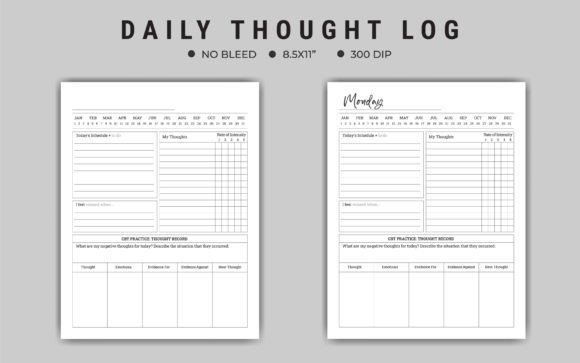
At its core, this product is a clean, minimalist workbook interior. It comprises two distinct yet connected formats repeated across the pages:
- A Daily Thought Log — a space for recording automatic thoughts, triggering situations, and immediate emotional reactions.
- A Thought Challenging Worksheet — a companion page that guides users to examine evidence, consider alternative perspectives, and arrive at a more balanced, realistic reframe.
The file package includes one high-resolution 300 DPI PDF and two JPG files, all sized at 8.5″ × 11″ with no bleed. This makes the interior genuinely print-ready and compatible with Amazon KDP’s paperback specifications. For those who prefer a fillable template, the PDF can be used digitally with annotation apps, turning it into a functional unhelpful thinking fillable template that fits seamlessly into a tablet-based workflow.
The structure isn’t cluttered with excessive coaching text. Instead, each page offers guided prompts—columns for the date, situation, automatic thought, emotion and its intensity, evidence for and against the thought, and a section for a new, balanced thought along with a re-rating of the emotion. This intentional simplicity keeps the focus on the user’s own reflective work, a design choice that enhances the resource’s versatility.
The Cognitive-Behavioral Framework and Why It Makes Sense in a Printable Format
The dual-page system mirrors the core steps of cognitive restructuring used in cognitive-behavioral therapy (CBT). By first logging an automatic negative thought—often distorted, exaggerated, or based on incomplete information—and then systematically challenging it, users begin to weaken old thinking patterns and build more realistic internal narratives. The Daily Thought Log, Thought Worksheet does not attempt to teach CBT from scratch, but it supplies the necessary scaffolding to practice it.
For someone already familiar with concepts like automatic negative thoughts and thought records, these pages function as a frictionless daily habit tool. The log manages the initial capture before the mind has a chance to rationalize or suppress the thought. Moving directly to the challenge automatic thoughts sheet while the emotion is still accessible grounds the exercise in immediate experience, rather than abstract reflection hours later. This sequence—capture, then challenge—can be a simple yet effective way to overcome negative emotions without getting stuck in rumination.
As a CBT workbook supplement, the material doesn’t compete with comprehensive therapy manuals; it fills a niche for repeated, everyday practice. That repetition is where real cognitive shifts occur, and a 120-page interior offers enough capacity for several months of consistent use.
Print Quality, Usability, and KDP Compatibility
Technical execution matters when you plan to print dozens or hundreds of copies, or when you want a crisp, professional-looking journal for personal use. The files are provided at 300 DPI, which guarantees sharp text and clean lines whether printed at home, at a local copy shop, or through KDP’s print-on-demand service. The 8.5″ × 11″ dimensions with no bleed meet KDP’s required trim size for standard composition-style notebooks, and the interior has been tested on the platform to confirm successful upload and printing.
From a self-publisher’s perspective, this removes the guesswork around formatting. The ready-to-upload nature of the PDF means less time adjusting margins or converting files, which is a considerable advantage for entrepreneurs building a catalog of therapy worksheets, self help printable journals, or mental health counseling aid resources. The clean design allows you to add your own cover, branding, or supplementary instructions without clashing with the interior layout.
For individual users, the no-bleed format eliminates the risk of losing content near the binding, and the generous size provides ample writing space. When used as a digital fillable on an iPad with a stylus, the same pages retain their structure; the lack of complex graphics ensures fast loading and a responsive experience in annotation apps like GoodNotes or Notability.
How Real-World Use May Look—and Where the Tool Excels
A typical week with the Daily Thought Log, Thought Worksheet might involve jotting down three or four triggering situations at work—an ambiguous email from a client, a curt remark from a colleague, an overlooked deadline. The log captures the raw automatic thought (“I’m about to lose this project,” “They don’t respect my time”). The adjacent worksheet then pushes the user to examine the evidence, list alternative explanations, and craft a more factual restatement. Over time, the gap between the initial emotional spike and the balanced reframe narrows, a dependable indicator that cognitive restructuring is becoming internalized.
The tool’s strength lies in its disciplined, repetitive structure. Unlike free-form journaling, which can drift into emotional venting, the guided format gently enforces a constructive direction. It’s particularly useful for people who prefer a low-friction routine: fill in the log when a difficult moment occurs, schedule 10 minutes later in the day to complete the challenge page. Because there’s no shortage of anxiety worksheet options that blend multiple techniques onto a single sheet, this separate-page approach stands out by giving each part of the process enough breathing room.
The fillable PDF adds another layer of flexibility. A professional who travels light can maintain a digital notebook without carrying a physical journal. For therapists, emailing the fillable file to a client between sessions can serve as a practical homework assignment that doesn’t require the client to own a printer. This hybrid usability—traditional print or digital completion—extends the resource’s reach beyond a single format.
Who Gains the Most from This Toolkit
The audience fit spans two distinct groups: self-publishers and end-users focused on mental well-being.
For KDP publishers, content creators, and entrepreneurs, the Daily Thought Log, Thought Worksheet interior is a proven asset. The 120-page count sits in a sweet spot for low-content books—substantial enough to feel complete, light enough to keep printing costs manageable and list prices competitive. Because the keyword landscape for mental health and self help tool products remains active, a well-designed interior combined with a thoughtful cover can carve out a niche without requiring a textbook’s worth of original content.
For direct users—professionals, freelancers, students, and anyone navigating high-stress environments—the worksheets offer a tangible method for managing anxiety and perfectionism. The resource doesn’t promise a cure, but it creates a consistent channel for interrupting destructive mental loops. Individuals already in therapy often find that supplementing sessions with a structured thought log accelerates progress, turning a challenge negative thoughts exercise into a personal daily ritual rather than a once-a-week assignment.
Coaches and counselors may incorporate the pages as part of a broader intervention. The clean layout means they can photocopy a handful of sheets without overwhelming a client with a dense book, and the fillable version can be integrated into a digital care package.
Honest Limitations and When Another Format Might Work Better
No single tool fits everyone, and this one assumes a certain baseline of self-awareness and motivation. The prompts are structured but not explanatory; users who are entirely new to cognitive reframing might feel lost without an accompanying guide or introductory booklet. For someone seeking a guided course with psychoeducation, a full CBT workbook that includes diagrams and in-depth explanations would be a better starting point. This interior works best as a practice journal rather than a standalone teaching resource.
The page count also means that after about three to four months of daily use, users will need to either purchase another copy or print additional sheets. While 120 pages is generous for a low-content book, it’s finite. For those who prefer a perpetual, undated digital system, a custom-built spreadsheet or app might offer more long-term scalability, though it would sacrifice the focused, distraction-free environment that paper or a single-purpose PDF provides.
Additionally, the “no-bleed” format, while excellent for KDP compliance and clean binding, leaves very narrow inner margins on printed copies. Some users may find writing near the spine slightly uncomfortable, especially in thicker books. Using the PDF as a loose-leaf print-at-home option sidesteps this, but it’s worth noting if you plan to order a perfect-bound paperback.
Consistency, Reliability, and Long-Term Value for Mental Habit Building
What makes a tool like this endure is its quiet consistency. There are no gimmicks or overly decorative elements that date the interior. The straightforward grid and line-based layout suit a professional’s taste, avoiding the excessively cutesy aesthetic that can deter some users from taking the work seriously. Over weeks and months, the cumulative effect of completing thought logs and challenge sheets builds a powerful paper trail of cognitive shifts. This record itself becomes motivating—flipping back to see how a once-paralyzing worry looks trivial after consistent reframing reinforces the skill.
From a publishing standpoint, the interior’s reliability is equally compelling. Tested on Amazon KDP and provided in 300 DPI files that meet technical specifications exactly, it reduces the risk of rejection or costly re-formatting. For those who have dealt with frustrating formatting errors when self-publishing, that reliability translates directly into saved time and fewer customer complaints.
As a self help printable resource, it integrates into broader toolkits gracefully. A user might combine it with a habit tracker, a gratitude log, or a sleep diary. The neutral, uncluttered design doesn’t compete with other inserts, making it a modular piece of a larger mental wellness system.
Ultimately, the Daily Thought Log, Thought Worksheet fills a specific, valuable gap. It’s not a comprehensive therapy program, nor does it pretend to be. But for anyone committed to systematically identifying and restructuring unhelpful thoughts—whether for personal growth, as a publishing product, or as a clinical supplement—it delivers a well-executed, adaptable, and professionally prepared tool that respects the user’s intelligence and autonomy.