Notice to Vacate: Your Guide to Rental Property Lease Termination
Every landlord, at some point, needs to ask a tenant to leave a rental property. Whether the lease is ending, the tenant has violated the agreement, or you need to reclaim the unit for personal use, the process starts with a single document: the notice to vacate. This isn’t just a courtesy letter—it’s a legally significant step that can protect your rights, prevent disputes, and keep your rental business running smoothly. Understanding how a notice to vacate works within landlord-tenant laws is essential for anyone managing a rental property. When done correctly, it sets clear expectations, reduces confusion, and provides a paper trail that may be invaluable later.
But the waters can get muddy fast. Every state has its own rules about timing, delivery, and content. A poorly written vacate letter can delay the termination of lease by weeks or even months, costing you time and rental income. This article walks through everything you need to know—from the legal foundations to practical drafting tips, including how an editable notice to vacate template can help you craft a compliant, clear document without starting from scratch.
What Exactly Is a Notice to Vacate?
A notice to vacate is a formal written statement from a landlord to a tenant, informing the tenant that they must leave the rental premises by a specified date. It is sometimes also called a lease termination notice or a tenant notice to quit. Unlike an eviction notice, which is filed with the court, a notice to vacate is the first official step in ending the tenancy. If the tenant complies and moves out, no court involvement is necessary. If the tenant ignores it, the notice becomes critical evidence when filing an eviction lawsuit.
There are two primary scenarios where a notice to vacate comes into play:
- End of a fixed-term lease: When a lease agreement is nearing its natural end and the landlord chooses not to renew, a notice to vacate ensures the tenant is aware of their obligation to move out. Many rental property leases require 30, 60, or even 90 days of advance written notice.
- Month-to-month tenancies: In a periodic rental arrangement, either party can typically end the agreement with proper notice—often 30 days, but it varies by jurisdiction. The landlord serves a landlord notice to vacate to initiate that process.
- Lease violations: When a tenant breaches the lease—repeated late payments, unauthorized pets, property damage, illegal activity—the landlord may issue a notice to cure or quit, or in severe cases, an unconditional notice to vacate without the option to remedy the violation.
Why a Proper Notice Protects Both Landlords and Tenants
At its heart, the notice to vacate exists to provide clarity and fairness. For the tenant, it’s a formal heads-up that allows them time to find new housing, plan a move, and tie up loose ends. Tenant rights are built into the process: the notice must be delivered in a way the law recognizes, and the timeline must be honored. If a landlord tries to force a tenant out without proper notice, they could face legal penalties, including damages for wrongful eviction.
From the landlord’s perspective, the notice is a shield. A legally compliant document demonstrates good faith and adherence to landlord-tenant laws. It memorializes the exact date the tenant was informed, the reason for termination, and the move-out deadline. Should the matter end up in court, a meticulous notice to vacate can shorten the process and strengthen the landlord’s case considerably. You avoid the “he said, she said” trap and keep the lease agreement enforceable.
Key Elements Every Vacate Letter Must Contain
No matter where your property is located, certain pieces of information are universally necessary. A solid notice to vacate rental property should include:
- The date the notice is issued. This starts the clock for counting the notice period.
- Names of all tenants on the lease. Include every adult occupant to prevent one person claiming ignorance.
- The full address of the rental property, including unit number if applicable.
- The date by which the tenant must vacate. Be precise, and ensure it complies with local timing rules.
- The reason for termination, if required. In some jurisdictions, a landlord must state a valid reason for ending a month-to-month tenancy (just cause eviction). In others, no reason is needed during a fixed-term expiration, but if the notice is for a lease violation, the specific infraction should be cited.
- Reference to the lease clause that gives the landlord the right to terminate, if applicable.
- Consequences of failing to move out, such as legal eviction proceedings, potential financial liability, and loss of security deposit claim.
- Contact information for the landlord or property manager for questions.
- A signature line for the landlord or agent, and sometimes a proof-of-service section to record how and when the notice was delivered.
Omitting even one of these details can jeopardize the termination of lease process. For instance, if you forget to specify the exact vacate date, a court might deem the notice invalid and restart the clock.
The Role of Landlord-Tenant Laws in Timing and Delivery
One of the most common mistakes is miscalculating the notice period. In many states, a month-to-month tenancy requires a full rental period of notice, which may not align with calendar months. If your lease runs from the 10th of each month, serving a 30-day notice on the 5th might not effectively end the tenancy until further out than you planned. Always check the lease agreement and state statutes.
Delivery method also matters. Simply sliding a note under the door or sending a text message may not satisfy landlord-tenant laws. Acceptable methods often include:
- Personal delivery to the tenant.
- Leaving the notice with a person of suitable age and discretion at the residence, plus mailing a copy.
- Certified mail with return receipt requested.
- Posting the notice in a conspicuous place on the property, along with mailing—sometimes called “post and mail.”
When in doubt, use a method that creates a verifiable record. Many landlords choose certified mail because it provides a signed receipt. Documenting every step protects you if the tenant later claims they never received anything.
Real-World Scenarios: When Do You Need to Send a Notice to Vacate?
Let’s look at a few typical situations that call for a notice to vacate rental property:
Scenario 1: Natural Lease End Without Renewal
You own a duplex and have a year-long lease expiring on June 30. You’ve decided to sell the property rather than re-rent. Your lease agreement requires a 60-day notice. By April 30, you hand-deliver a notice to vacate stating the lease will not be renewed and the tenant must be out by June 30. Because you followed the agreement’s terms and provided the notice in writing, the expectation is clear.
Scenario 2: Selling an Occupied Property
A new buyer wants the home vacant upon closing. If you have a tenant on a month-to-month arrangement, you serve a proper landlord notice to vacate in accordance with your state’s timeline—often 30 or 60 days. The notice should not only state the termination but also mention that the property is being sold and the sale contract requires vacancy.
Scenario 3: Chronic Lease Violations
Your tenant has paid rent late four times in six months. You’ve issued warnings but the behavior continues. Your state allows a 7-day notice to cure or quit for non-payment, but for repeated violations, you might be able to issue a 14-day notice to vacate without the option to cure. This is where precise language matters; citing the specific violation and referencing the lease clause shows the tenant exactly why they’re being asked to leave.
Common Pitfalls That Can Invalidate a Vacate Letter
Even well-intentioned landlords stumble into legal quicksand. Watch out for these traps:
- Using the wrong notice period. This is the number one error. Always confirm the statutory minimum before sending anything.
- Failing to include all tenants. If a lease lists two or more tenants, the notice should name each one. A single omission can be exploited.
- Vague reasons. If you’re terminating for cause, be specific. “Violation of lease terms” isn’t enough if challenged. Describe the offense and dates.
- Retaliatory or discriminatory motives. Landlord-tenant laws prohibit terminating a tenancy in retaliation for a tenant exercising their legal rights (like reporting health hazards) or for discriminatory reasons. A notice that appears to stem from such motives can backfire spectacularly.
- Ignoring local rent control ordinances. Some cities require a valid “just cause” for eviction even when a lease ends. A blanket notice without a recognized reason can be void.
How an Editable Notice to Vacate Template Simplifies the Process
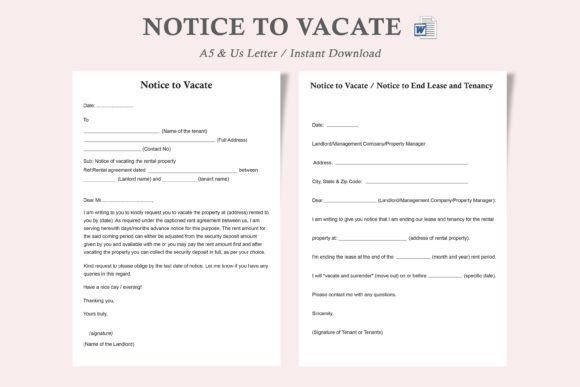
Because the legal stakes are so high, many property owners turn to professionally drafted templates. An editable notice to vacate is not just a fill-in-the-blank form; it’s a tool that embeds legal awareness into the document’s structure. A well-designed template includes all the essential sections: property address, tenant name, vacate date, reason, and signature blocks. By using a legally compliant base, you reduce the chance of missing a required component. Some templates even come in multiple formats—such as a Word file for easy editing, and PDF or JPEG versions for a fixed format—so you can adapt to your needs. An editable notice to vacate can be reused across properties, saving time and ensuring consistency in your rental property business.
The value of a template goes beyond convenience. It provides peace of mind. Rather than researching each element from scratch every time, you start with a framework that reflects best practices in termination of lease communication. However, it’s crucial to remember that no template is a substitute for knowing your local laws. You must still verify the notice period, delivery method, and any specific required language. In some areas, you may need to attach a separate form outlining tenant rights or a list of legal aid resources.
Adapting a Notice to Vacate for Different Situations
An editable notice to vacate shines when you need to tailor the message. Templates often come with sections that can be customized for the specific reason: end-of-lease, non-payment, violation, or owner move-in. This flexibility is important because the tone and required disclosures can differ. For an owner move-in eviction, some jurisdictions require you to include a certificate that you, in fact, intend to occupy the unit. For a violation, you might need to give the tenant a chance to fix the problem within a set number of days. By using a template that accommodates such variations, you create a vacate letter that fits the exact legal scenario without starting from zero each time.
Let’s break down a practical example: You’re terminating a month-to-month tenancy because you plan to renovate the unit extensively. Your template’s dropdown or fillable area might let you select “Owner Renovation” as the reason. You then adjust the notice period according to local law—perhaps 60 days. The editable fields let you insert the correct date, the specific renovation plans (briefly), and any required disclaimers. This approach documents your intent clearly and helps prevent a tenant from later claiming you evicted them to raise the rent.
When to Seek Legal Advice Despite Using a Template
A high-quality notice to vacate rental property template is a robust starting point, but it cannot replace an attorney’s guidance in complex cases. If the tenant has filed for bankruptcy, is under a rent subsidy program with additional rules, or has a disability that may require reasonable accommodation, the situation calls for professional review. Similarly, if you suspect the tenant will fight the notice aggressively, consulting a landlord-tenant lawyer early can help you head off mistakes that could delay the eviction for months. Think of the template as your day-to-day tool, and legal counsel as your emergency brake.
Putting It All Together: A Step-by-Step Workflow
Here is a reliable workflow for creating and serving a legally compliant notice to vacate, using an editable notice to vacate template as your aid:
- Review the lease agreement and state/local laws to confirm the required notice period and permitted reasons for termination.
- Select your template. Ensure it includes fields for all necessary elements: dates, names, address, reason, signature, and proof of service.
- Fill in the details accurately. Use the tenant’s full legal name as it appears on the lease. Double-check the vacate date against a calendar to ensure compliance.
- Add any jurisdiction-specific attachments, such as a notice of tenant rights or a cover sheet required by your court system.
- Choose a legally recognized delivery method. If using certified mail, keep the receipt and the tracking number. If delivering in person, consider bringing an unrelated witness and documenting the date and time on a separate proof of service form.
- Retain a copy for your records. The signed original (or a scanned copy) should be stored in the tenant’s file indefinitely. This becomes your evidence if the matter escalates.
- Follow up. If the tenant hasn’t moved out by the deadline, consult your attorney immediately about filing for eviction. Do not attempt self-help measures like cutting off utilities or changing locks—those are illegal in virtually all jurisdictions.
Conclusion: Making the Notice to Vacate Work for You
In the world of rental property management, clear communication is everything. A carefully prepared notice to vacate is more than paperwork; it’s a cornerstone of professional landlord practice. By understanding the interplay between the lease agreement, termination of lease rules, and tenant rights, you can navigate the vacate process with confidence. Whether you use a meticulously crafted editable notice to vacate template or draft each letter by hand, the goal is the same: a smooth, legal, and respectful end to the tenancy. Take the time to get it right, document everything, and when in doubt, seek local expertise. Your diligence today can prevent a courthouse headache tomorrow.