Designing a Personalized Path to Well-Being with the Self Care Wellness Planner Bundle
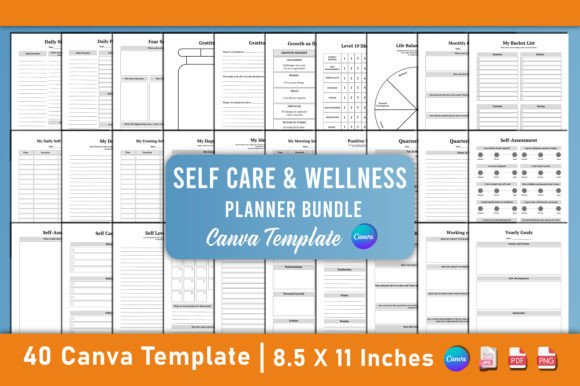
Self-care often gets reduced to a one-size-fits-all checklist: drink water, meditate, sleep eight hours. But when your internal landscape shifts daily—energy, stressors, goals—a rigid template falls short. That’s where a thoughtfully structured, editable system changes everything. The Self Care Wellness Planner Bundle isn’t just a collection of pages; it’s a framework you reshape to match your language, your rhythms, and your unique definition of balance. Whether you’re a therapist looking for client resources, a busy professional carving out mental space, or a creator building a new routine, having forty meticulously designed templates at your fingertips—all modifiable in Canva—means your journal grows with you instead of collecting dust.
Why Customization Matters in Self-Care Planning
Most guided journals assume a universal user: someone with morning hours to spare, no chronic illness, and a linear life. Reality is messier. The Editable Self Care Wellness Planner Bundle Canva Template addresses this head-on by giving you full control over every prompt, color, and layout. If the “Daily Check-In” page needs a section for pain tracking instead of productivity scores, you can alter it in minutes. If an affirmation feels hollow, you replace it with your own mantra. This isn’t about redesigning from scratch—it’s about removing friction so the tool conforms to you, not the other way around. For neurodivergent users, for example, visual overstimulation can make journaling aversive; the ability to mute colors and simplify fonts makes the practice accessible rather than exhausting.
Templates That Anchor Your Daily Practice
The bundle’s forty templates cover a wide spectrum, but the daily-use pages form the sturdy spine of any self-care routine. Let’s explore how a few of them work together when you commit to a morning-to-evening rhythm.
Starting the Day with Intention and Honesty
The Daily Check-In page isn’t a vague “How do you feel?” prompt. In its original form, it guides you through emotional temperature, physical state, and immediate priority setting. Paired with the Morning Self-Care Routine template, you create a ritual that might include breathwork, stretching, or writing one sentence from a dream. The adjacent Affirmations page lets you anchor positive beliefs—but because it’s editable, you can rotate affirmations seasonally or tie them to a current challenge. The Daily Manifest page shifts focus toward what you’re calling in, blending practical to-do thinking with mindset work. These four pages, used in sequence, build a cognitive launchpad that isn’t abstract; it’s directly tied to the day ahead.
Midday Realignment and Gratitude
Many planners forget the messy middle of the day. The Gratitude Log and Gratitude Jar templates serve different functions here. The log is a straightforward list, but the jar concept adds a tactile, visual layer—even digitally, it prompts a sense of accumulation. You might edit the jar page to hold weekly reflections instead. The Daily Planner template, fully customizable, can morph into a time-blocking layout, a Pomodoro tracker, or a simple priority matrix. A mid-afternoon visit to the Positive Thinking template, where you rewrite a negative thought and examine evidence, can disrupt anxiety cycles effectively. These are not isolated exercises; they’re prompts you weave into the natural pauses of your workday.
Winding Down with Structure and Softness
Evening routines often collapse because they lack boundaries. The Evening Self-Care Routine template offers a soft checklist that might include screen-off time, herbal tea, or reading. Pair it with the Daily Gratitude page (distinct from the log—this can be a single deep-dive entry) and the Fear Setting exercise, a powerful stoic tool that helps you name what you’re afraid of, mitigate it, and recognize that the cost of inaction is often higher. The Self-Assessment and Self-Assessment1 pages, editable to track different dimensions, let you score the day on energy, connection, purpose—whatever metrics matter to you. Over time, patterns emerge that no generic journal could surface.
The Anatomy of a Complete Wellness Toolkit
Beyond daily pages, the bundle’s structural templates turn scattered efforts into a coherent system. The Belongs To page is deceptively simple: it’s a ownership statement, but in a Canva template, you can add a personal manifesto or a photo that grounds you. The Accountability page moves beyond “check off a task” toward deeper self-contracts. The Life Balance Wheel is a classic coaching tool that visualizes satisfaction across multiple domains—career, relationships, health, creativity—and the editable version allows you to rename slices to match your actual life categories. The Level 10 Life Inventory (often a misnomer; the bundle includes it as a life rating scale) pushes you to set specific goal targets for each area, creating a baseline before quarterly planning begins.
The Vision Board template is digital but print-ready, meaning you can source images from your own collection, layer them in Canva, and have a physical board that matches your aesthetic. The Self-Care Activity Calendar turns intention into rhythm, spreading activities across a month so nothing feels forced. These tools, used together, move self-care from isolated acts to a designed ecosystem.
How the Canva Editing Feature Transforms Your Journal
The power of the Editable Self Care Wellness Planner Bundle Canva Template lies in its compatibility with Canva’s free platform. You don’t need design skills to make meaningful changes. Click on any text box to rewrite prompts. Swap the included color palette to match your branding if you’re a coach sharing with clients. Replace placeholder fonts with ones that feel easier to read or more aligned with your personality. Rearrange elements on a page—maybe the Weekly Planner works better for you with the gratitude section at the top instead of the bottom. You can even extend a template: if the Bucket List page needs room for 50 items, duplicate the layout. This flexibility means the bundle never becomes obsolete. As your self-care language evolves, so does your planner.
Long-Term Vision and Reflection Tools
Daily practices gain potency when nested within quarterly and yearly reviews. The bundle includes multiple quarterly goal pages: Quarterly Goals, Quarterly Goals 1, Quarterly Goals 2, and Quarterly Goals 3—each designed to look back and forward in slightly different formats. You might use one for a career review, another for health, another for relationships. The Quarterly Reflection template prompts deeper questions about what worked, what didn’t, and what needs adjustment. The Yearly Goals set (again with variants) helps you cascade annual visions into quarterly actions, ensuring alignment. The Monthly Reflection page sits between weeks and quarters, offering a rhythm that prevents goal drift. And the Weekly Reflection, paired with the Weekly Planner, creates a consistent check-in cadence that many people skip because they don’t have a dedicated container for it.
Equally important are the mindset-oriented templates that run underneath all this activity. Growth is a Fixed Mindset is a provocative title—it actually guides you to identify where a fixed mindset still holds you back and how to shift toward growth. Working on Mindset offers a more open-ended journaling space. The Self Love Letter is a potentially transformative page: you write to yourself with compassion, and it’s editable so you can create a series of letters over time, perhaps one per season. The My Happy Place visualization exercise grounds you in sensory detail, a resource to revisit when stress peaks.
Print and Use: From Screen to Tangible Routine
Digital editing is freeing, but the endgame for many users is a physical planner they can hold. The bundle delivers high-quality print-ready 8.5x11 inch PDF files, formatted for easy home printing or professional binding. You might print the entire set and disc-bind it, creating a fully custom book. Alternatively, pick only the pages that serve your current season—maybe the My Daily Self-Care Routine, Gratitude Jar, and Level 10 Life Inventory—and keep them on a clipboard. Because the PDFs come directly from your edited Canva designs, what you see on screen is exactly what prints. No misalignments or font substitutions. This makes the bundle ideal for creators who want to offer a physical product to their audience; you can edit the templates to reflect your brand’s voice, export, and sell or share.
Who Benefits Most from This Planner Ecosystem?
- Therapists and coaches who need adaptable client tools. The Self-Assessment and Life Balance Wheel are session-ready, and editing allows removal of any triggering language.
- Chronic illness warriors who track symptoms alongside self-care. The Daily Check-In can morph into a symptom log with energy budgeting prompts.
- Entrepreneurs craving work-life integration without burnout. The Weekly Planner and Quarterly Goals pages bridge personal and professional realms.
- Beginners who find overwhelming blank journals. The structured yet editable prompts reduce decision fatigue while still inviting personalization.
- Stationery creators looking for a base to build upon. The Canva link provides a legal, flexible foundation for derivative products with clear attribution.
Observations on Implementation
From a usability standpoint, the Self Care Wellness Planner Bundle solves a common pain point: the mismatch between intention and format. Many users report starting guided journals only to abandon them because a certain prompt felt irrelevant or a layout caused eye strain. Here, the editability removes that silent barrier. For instance, the Fear Setting template, adapted from Tim Ferriss’s method, works brilliantly for some but can feel overly clinical for others; you can soften the language or add an additional column for “What support do I need?” The My Dreams page, often romanticized, can be rewritten as a pragmatic “Future Scenarios” exercise for analytical minds. This level of adaptation, done once, drastically increases the likelihood of sustained use.
Another observation: the bundle’s structure encourages what psychologists call self-continuity. By repeatedly visiting themes like gratitude, mindset, and goals across different time horizons and formats, you build a richer, more coherent self-narrative. The My Ideal Life template, revisited every quarter, becomes a compass rather than a fantasy. The Accountability page, when you honestly fill it out and keep it visible, becomes a contract with your future self. And because you can print these pages, they live outside the digital noise—tangible artifacts that anchor reflection.
It’s worth noting that the high-quality PDF output ensures that even heavily edited designs retain their crispness. The 8.5x11 inch format is standard, so finding binders, sheet protectors, or disc-binding supplies is effortless. For those who prefer a digital-only workflow, the editable Canva templates can be used on tablets with stylus input, blending the tactile feel of handwriting with the flexibility of digital storage.
Making the Templates Truly Your Own
Start by identifying the five to seven templates you’ll use consistently. Open the Canva link, duplicate the entire set (so you preserve the originals), and begin tweaking. Change the color story to something that calms or energizes you. If “Affirmations” feels too woo-woo, rename it “Evidence Log” and use it to record daily wins. The Self Care Goals page can be expanded into a full goal-setting file with monthly milestones. The Weekly Reflection might become a data-rich review if you add numbers or ratings. Don’t feel obligated to use all forty pages; curation is part of the self-care. A smaller, highly relevant planner gets used; a bloated one induces guilt.
The beauty of the Editable Self Care Wellness Planner Bundle Canva Template is that it doesn’t demand perfectionism. Because you can always re-edit, experimentation is low-stakes. Try a new layout for a week. If it doesn’t work, revert. Over time, your planner will reflect your evolving inner landscape, and that’s the ultimate goal: a self-care tool that feels as alive and dynamic as the person using it.